

1920s Columbia Grafonola wind up gramophone model 112A, with selection of records and packet of new needles
Columbia Gramophone model 112A with records and needles
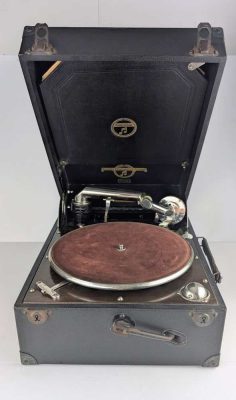
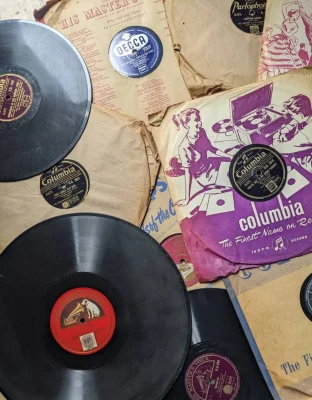
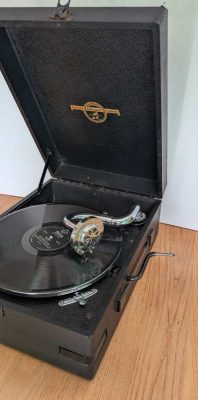
A 1920s antique Columbia Viva Tonal Grafonola Gramophone, model 112A, with a selection of bakelite ’78’ gramophone records and a packet of new needles.
With a lovely mahogany top to contrast with the black rexine, this gramophone is working very well.
The Gramophone will be sent with a selection of five records in the dedicated compartment on the underside of the lid. There is a tab which pulls towards you on the underside front of the lid to release the record holder.
The Grafonola differs from a Gramophone in that this amplifies the music with just the ‘sound box’ which is the round piece to which the needle is attached, rather than requiring a large exterior horn to be heard. This version is more compact and so easier to store and transport.
The impressive fact about these gramophones is that they work entirely without a power source besides the manual wind up lever which is unfolded from the front of the case and wound to power the spinning turntable.
The sound is transmitted acoustically via the needle, through the ‘soundbox’ angled, as it should be at around 60° which is connected to the tone arm.
In case you are unfamiliar with 78s, these types of record preceded vinyl. They are usually made of shellac and are much stiffer and more brittle than vinyl records. They are smaller too, and run at around 78rpm as opposed to 33 or 45 with vinyl.
The needles are made of soft steel and can be purchased cheaply online in bulk (they should ideally be changed every side of a record due to degrading sound quality). They are quickly and easily changed with a simple thumbscrew.
This type of needle that gramophones use is totally different to the modern stylus, and if you attempt to play vinyl records on a gramophone, the vinyl will be destroyed!
A vintage tin of needles will be provided. There is a pot to the front right for your discarded, used needles.
The lever to the back left is a brake for the turntable for use when turning the record over and packing away.
The lever to the front left plays the record as intended at 78rpm in the centre, and can be slowed or sped up to match the tempo of your foxtrot…
The polished case is generally in good condition. The latches work smoothly and the mechanics are working well. There is a knob to the back left which is pushed to release the lid to close it. The case has steel corners and a nice leather handle. There are marks commensurate with its near century of age but overall it has a fantastic look and works well.
I have many gramophone records for sale for use with this and similar gramophones:
This Columbia Grafonola is a fantastic looking piece of music history. It is a wonderful period piece to wow your friends and family and a great way to get a party started!
******* Watch and hear this gramophone! https://youtu.be/9iHBJEOxdX0?si=wDuLjxCy6X7OrzLR *******
I have written a full guide on how to use gramophones on my website, where this gramophone and everything else is cheaper:
Measures 41cm deep X 30cm wide X 17cm tall with lid closed.
Columbia Gramophone model 112A with records and needles
A 1920s antique Columbia Viva Tonal Grafonola Gramophone, model 112A, with a selection of bakelite ’78’ gramophone records and a packet of new needles.
With a lovely mahogany top to contrast with the black rexine, this gramophone is working very well.
The Gramophone will be sent with a selection of five records in the dedicated compartment on the underside of the lid. There is a tab which pulls towards you on the underside front of the lid to release the record holder.
The Grafonola differs from a Gramophone in that this amplifies the music with just the ‘sound box’ which is the round piece to which the needle is attached, rather than requiring a large exterior horn to be heard. This version is more compact and so easier to store and transport.
The impressive fact about these gramophones is that they work entirely without a power source besides the manual wind up lever which is unfolded from the front of the case and wound to power the spinning turntable.
The sound is transmitted acoustically via the needle, through the ‘soundbox’ angled, as it should be at around 60° which is connected to the tone arm.
In case you are unfamiliar with 78s, these types of record preceded vinyl. They are usually made of shellac and are much stiffer and more brittle than vinyl records. They are smaller too, and run at around 78rpm as opposed to 33 or 45 with vinyl.
The needles are made of soft steel and can be purchased cheaply online in bulk (they should ideally be changed every side of a record due to degrading sound quality). They are quickly and easily changed with a simple thumbscrew.
This type of needle that gramophones use is totally different to the modern stylus, and if you attempt to play vinyl records on a gramophone, the vinyl will be destroyed!
A vintage tin of needles will be provided. There is a pot to the front right for your discarded, used needles.
The lever to the back left is a brake for the turntable for use when turning the record over and packing away.
The lever to the front left plays the record as intended at 78rpm in the centre, and can be slowed or sped up to match the tempo of your foxtrot…
The polished case is generally in good condition. The latches work smoothly and the mechanics are working well. There is a knob to the back left which is pushed to release the lid to close it. The case has steel corners and a nice leather handle. There are marks commensurate with its near century of age but overall it has a fantastic look and works well.
I have many gramophone records for sale for use with this and similar gramophones:
This Columbia Grafonola is a fantastic looking piece of music history. It is a wonderful period piece to wow your friends and family and a great way to get a party started!
******* Watch and hear this gramophone! https://youtu.be/9iHBJEOxdX0?si=wDuLjxCy6X7OrzLR *******
I have written a full guide on how to use gramophones on my website, where this gramophone and everything else is cheaper:
Measures 41cm deep X 30cm wide X 17cm tall with lid closed.